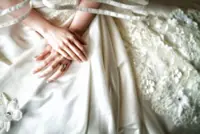
If you are wondering what to do with your mother's wedding gown after wearing it yourself, with no future generation to pass it on to, consider this – clothes are repositories of joy and grief, experience and memory, and one would even argue, among the most powerful wormholes to our personal pasts.
Sentiment is always going to be part of the story.
Whole books have been devoted to this phenomenon, including Love, Loss, And What I Wore, Ilene Beckerman’s 1995 memoir through clothes, and, more recently, Worn Stories, Emily Spivack’s 2014 collection of essays about individual histories contained in garments.
That’s why it is so hard to throw clothes away (at least the ones that aren’t made to be disposable).
It’s like throwing away a potential family relic and can seem almost sacrilegious.
Many parents feel it when they come across the clothes their now-grown children wore as youngsters. They are the last remnants of childhoods that have otherwise disappeared.
Read more: Western brides embrace multi-look wedding fashion, a trend long popular in Asia
This is even more complicated when the item in question has been handed down over time, like a mother’s wedding dress.
That dress is both a symbol of her life and the life of her times. You’ve heard of anthropomorphism? This is fashionthromorphism.
At the same time, there are limits to what can fit in our closets or how much we can store. There’s a fine line between hoarding and heritage. And there is liberation in letting go of the past.
So what to do?
“Being in the closet of someone deaccessioning treasured possessions is an intensely personal experience,” said Cameron Silver, a luxury brand consultant and the founder of Decades, one of the original high-end vintage stores, who also advises clients on closet organisation.
“I have often felt more like a therapist than a fashion consultant. My role is never to persuade someone to relinquish something prematurely. Rather, it is to help them reflect on why they are keeping it and whether it still serves a purpose in their life.”
He suggests starting with a few simple questions: “Does it fit? Will I ever realistically wear it again? And perhaps most revealing of all: How would I feel if this item were lost or stolen?”
Depending on the answers, there are a few options.
First, transforming the dress into another garment.
Wearing its history in a new form could make it feel like a secret password to the past. But doing so is taking the garment away from its original purpose, and something could be lost in translation.
Second, giving the dress a second life. If the Salvation Army doesn’t seem right, there are organisations like Brides Across America, which donates wedding gowns to engaged military couples and emergency medical workers who might not otherwise be able to afford them.
When opting for this approach, Emily Spivack suggests “writing a little note about the provenance of the dress and attaching it, so whoever gets it next gets the story too”.
Third, creating a sort of memory box.
Spivack runs workshops in which attendees “show up with a garment that had family significance and we document it, take photos and write the story”, she said.
“Then they feel like they have processed it and can part with it.”
The story can also be passed around to other family members.
Finally, schools like Smith College, Drexel University and Ohio State University have begun collecting garments exactly because of their quotidian rather than artistic value.
Unlike traditional costume collections, which are often based on the unique qualities of a textile or its place in the design canon, these collections use clothes as teaching objects, most often to elucidate the lives of women (another option going with the academic route: theatre departments).
Denise Green, the director of the Fashion + Textile Collection at Cornell University, said that there were “nearly 350 wedding gowns and wedding-related accessories among our more than 11,000 objects”.
Read more: Second-hand chic: Dutch brides embrace circular fashion for greener weddings
That includes a 1942 wedding gown created by British dressmaker Cylka Berke for her own wedding in wartime London to “maximise yardage and minimise cut waste”.
Even though most people haven’t heard of Berke, Green said, the dress itself “tells stories of wartime rationing, design innovation and the continuity of ritual and fashion amid strife”.
Not only that, she said, but “because it was not made of silk, which was needed by the military for parachutes, escape maps and blood chits during World War II, the rayon gown remains a remarkably bright white”. – ©2026 The New York Times Company
This article originally appeared in The New York Times.