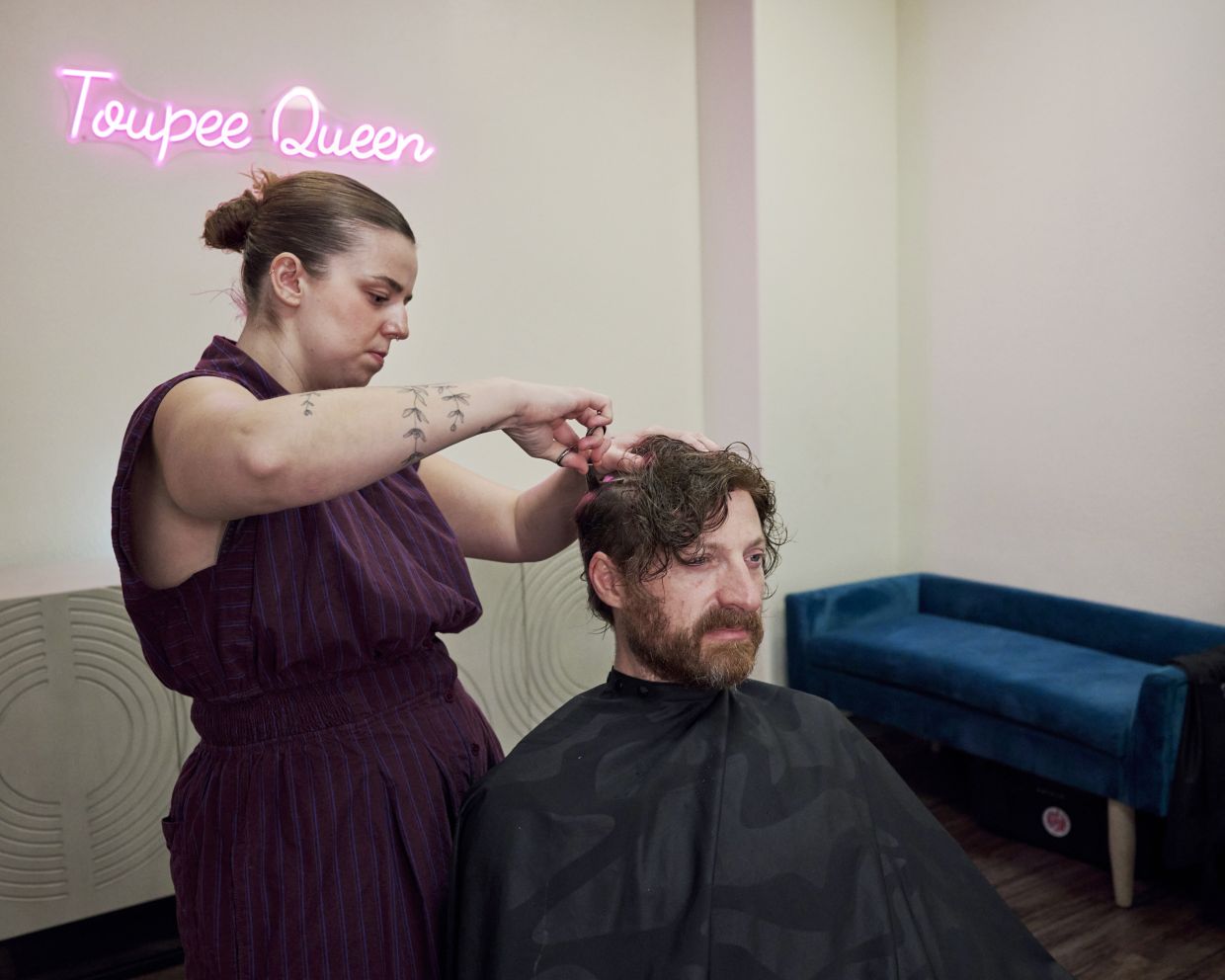
As Luke Williams looked in the mirror from his salon chair, he debated how short to cut the hair on the sides of his head. The top was already shaved in preparation for his new hairline.
He told Emily Cheney, a toupee artist, that he would defer to her expertise because she was the professional.
“’Cause I’m the queen!” she exclaimed in response.
Cheney, 25, the self-crowned monarch of nonsurgical hair restoration, has developed a strong brand thanks to the 1.4 million people who follow her on TikTok and Instagram, where her display name is Toupee Queen.
In a small one-room salon tucked inside a building in downtown San Diego, Cheney fits men, most of whom are in their late 20s, with toupees.
Her work, which she has been documenting on social media for five years, routinely draws millions of views, with transformation videos that showcase the before and after of a toupee installation.
Toupees, which have been rebranded by some as hair systems and are called cranial protheses by medical professionals, have become an unexpected fixture on social media, with both clients and stylists documenting the low-risk method of reinventing a hairline.
“I was struggling to come up with something using the term ‘hair system,’” Cheney said about how she landed on her title.
After some deliberating, the Toupee Queen was born, with a pink neon sign on her wall making it official.
Read more: Six-pack abs, nice skin, full head of hair? How men fret about their looks too
Cheney’s social media success allowed her move from Utah to San Diego last year, and it is how many clients find her.
But she also sees her videos as a way of pushing back against the stigma that so many men face when they engage in anything cosmetic.
“When I decided that one of my goals was to normalise toupees and male cosmetics and femininity among men, I decided that the best way to do this is to use the real word,” Cheney said of toupees.
“We can’t keep changing the word and expect it to be normalised.”
Williams, 44, said his hairline began receding in his 20s. After evaluating his options, including a hair transplant, he decided two years ago that he would go with a toupee.
This was, however, his first visit with Cheney, whom his wife had found on Instagram.
“I didn’t realise the technology was quite as good as it was, and they looked as real as they do,” Williams said, adding that the fuller head of hair had given him a confidence boost, particularly when going to work or meeting new people.
“Ideally, I’d have nice natural hair,” he said. “But if you don’t have it, you’ve got to buy it.”
Many of Cheney’s clients have a similar story.
Ben Sherry, 26, got his first toupee with Cheney in May. He is open to more permanent solutions in the future, he said, but this is a “Band-Aid” for now.
“The support that I’ve gotten has been great,” Sherry said in reference to his TikTok videos documenting his experience.
“And then, obviously, my perception of myself has also improved tremendously.”
Restoring confidence
Male-pattern baldness is a common condition that affects up to half of men by 50. Although the loss is physical, experts said the experience often influences how men feel.
Viren Swami, a professor of social psychology at Anglia Ruskin University whose research focuses on the psychology of body image, said hair loss could affect confidence in interpersonal relationships and social relationships, which in turn might have a negative impact on mental health.
“Losing your hair doesn’t necessarily mean you suddenly become depressed,” Swami said.
“You might feel sad, you might feel like something’s changed. But that then in turn has an impact on how you negotiate the world around you.”
Sherry said that before getting a toupee, his hair was the first thing he noticed when he looked in the mirror, and he hated it.
“It does take a toll,” he said.
Read more: Movember calls for men to grow a moustache, but some just struggle with it
An elaborate process
At Cheney’s salon in San Diego, she runs an efficient, one-woman operation.
First, she meets with potential clients through virtual consultations. If they decide to proceed, they come in for a two-hour application appointment, which includes shaving the top of their head and working to colour- and texture-match toupees to their natural hair.
This is followed by washing the toupee, applying it to the scalp with three to four coats of medical-grade glue, and a hair cut and styling.
The applications cost US$1,400 (approximately RM5,935) for the initial installation – she provides a discount for those willing to be featured in her social media videos – and require daily maintenance, as well as a monthly glue refresh.
A new toupee is recommended every two to three months, she said.
The hair pieces come from Toupees By Argyle, a small business owned by Cheney’s mother, Anndrea Argyle, who introduced her to the industry.
That relationship allowed Cheney to create custom “blueprints” for her stock toupees.
As Cheney begins an installation, she sings along to music and chats with her clients, often sprinkling in affirmations about how the look is “serving already”.
The number of people who do toupee applications is small, she said, and lacks community, partly because of the shame associated with wearing them.
Her attempts to remove that shame, and to use the word toupee, have not always gone over well with her peers.
“I feel rejected by the industry,” Cheney said. “And I did feel a bit lonely, but the changes are happening.”
She added: “If the industry won’t adjust with us, then we will build a new industry that is kinder and more happy to deal with change.” – ©2025 The New York Times Company
This article originally appeared in The New York Times.