Barcelona is the World Capital of Architecture in 2026. One reason for this is that another tower of the Sagrada Família will be formally completed on the anniversary of the death of its creator, Gaudí. But there are more reasons to visit. — Photos: Andreas Drouve/dpa
After more than 140 years of construction, the Sagrada Familia has never known silence - and for many in Barcelona, that is part of its charm.
The constant clatter of cranes and scaffolding around the monumental church designed by architect Antoni Gaudí barely fazes journalist María Jesús Tomé.
"Every time I see the Sagrada Familia, it impresses me as much as it did on the first day," she says. Tomé has personal ties to the mammoth building.
She lived next door to it for many years and had a view of the towers from her bedroom. Her son was baptised and received communion in the crypt where Gaudí is buried.
Strangely enough, she doesn't want the church to ever be finished after more than a century of construction: "Then it would lose its charm for me. I only know it as a building site."
The Sagrada Familia will soon be writing a new chapter in its history. On June 10, 2026, just in time for the centenary of Gaudí's death, the tower of Jesus Christ will be inaugurated.
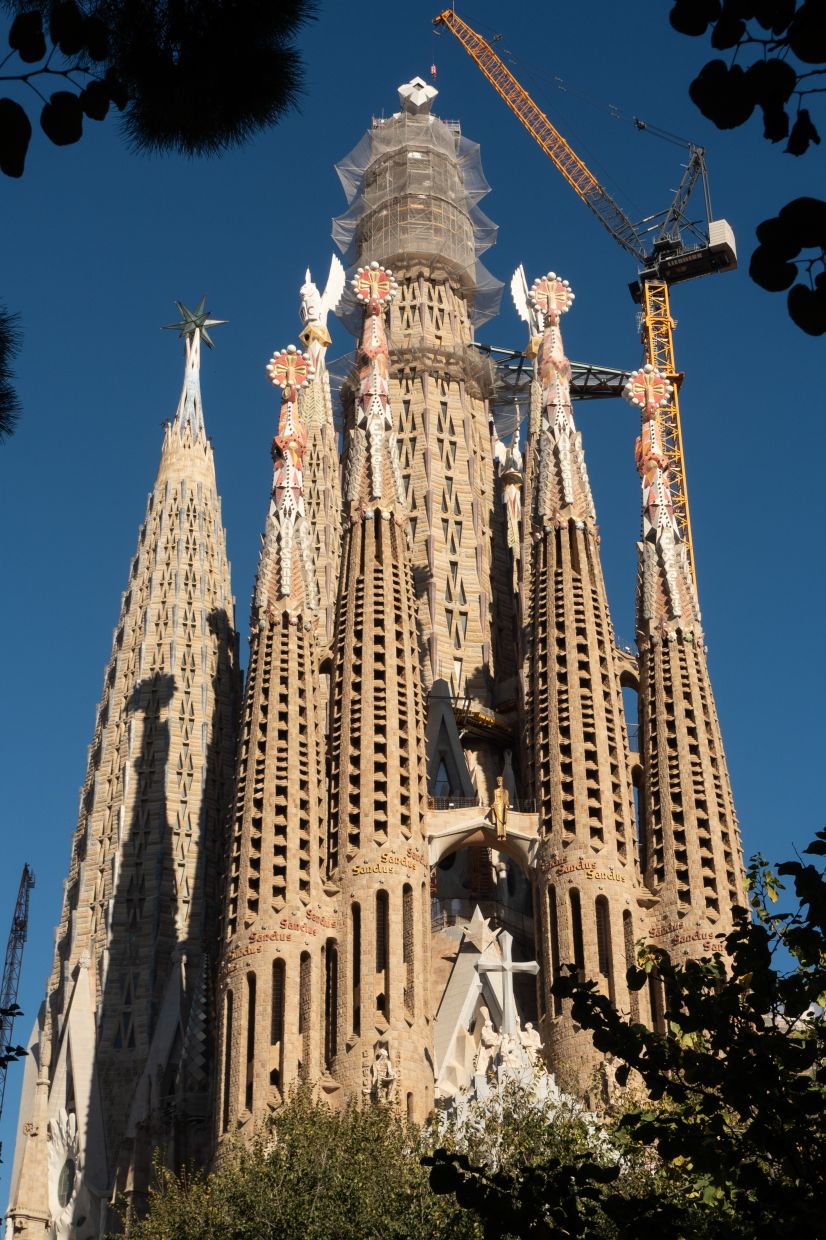 This is what work on the world's tallest church tower currently looks like at the Sagrada Familia. — Photo: Andreas Drouve/dpa
Topped with a cross from a workshop in southern Germany, it will be the tallest church tower in the world at 172.5 metres.
It will surpass the previous record-holder in Germany - the Ulm Minster, a Gothic church with a 161.5 metre-high steeple.
The Basilica Notre-Dame de la Paix in the Ivory Coast and the Cologne Cathedral follow with 158 metre-high and 157.2 metre-high towers respectively.
Barcelona will also hold the title of World Capital of Architecture in 2026, which is regularly awarded by the International Union of Architects.
While this celebration broadens attention to other masters and works, Gaudí remains in a league of his own.
A church financed by the people
Gaudí began the Sagrada Familia in 1883 under the auspices of the "Spiritual Association of Devotees of St Joseph," funded by private donations rather than public money.
Laia Vinaixa, director of the Sagrada Familia Documentation Centre, notes that Gaudí initially sought contributions from the upper middle class, but funding declined during World War I.
"The Sagrada Familia was threatened with closure. So from 1915, entrance fees were charged: one peseta each for access to the design models and the unfinished towers," Vinaixa says.
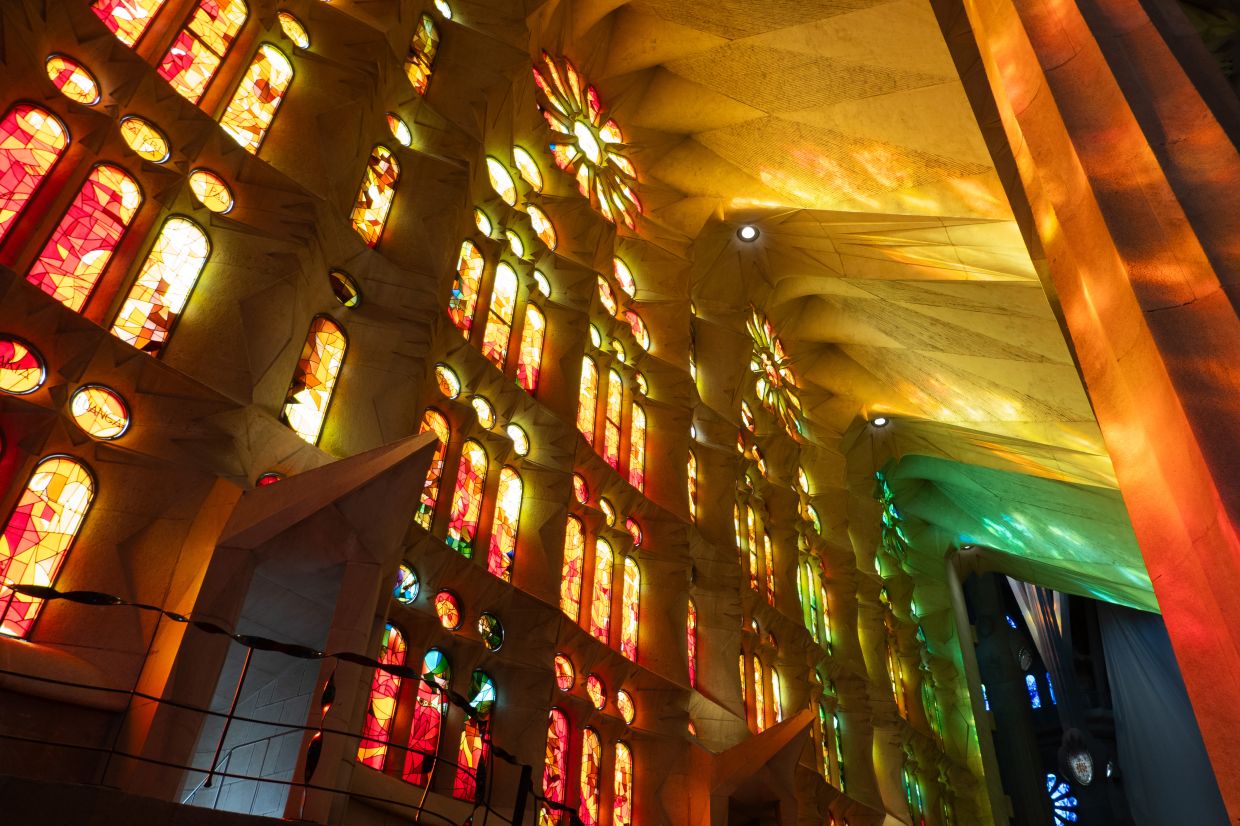 Inside the Sagrada Família, the sloping forest of columns has a fairytale-like effect. The light floods through the stained glass windows in an almost unreal way. — Photo: Andreas Drouve/dpa
Today, the income from almost 5 million visitors a year guarantees the continuation of the project, for which chief architect Jordi Faulí is responsible.
As a child, he remembers playing in the park in front of the Sagrada Familia and watching the towers grow. "We are working absolutely faithfully to Gaudí's plans and models," assures Faulí.
Although the originals were destroyed in the Spanish Civil War of 1936-39, there were enough descriptions and photographed sketches from before. Gaudí, often apostrophised as the "architect of God," planned a building with 18 towers.
"Every element of the Christian faith was to be represented: the central tower of Jesus Christ, the tower of Mary, the towers of the twelve apostles and the four towers of the evangelists, without which we would know nothing of the life of Christ," says Faulí. "He considered everything: the structure, the material, the building and the people whose hearts he wanted to fill."
Still a work in progress
Gaudí once said something prophetic about the project, quoted again by Faulí: "People from all over the world will come to see what we are doing here."
And that will take some time yet. Four more towers are missing. Faulí hardly dares to make predictions: "Maybe we'll have started in 10 years' time. Or not until 2040. Only God knows the future."
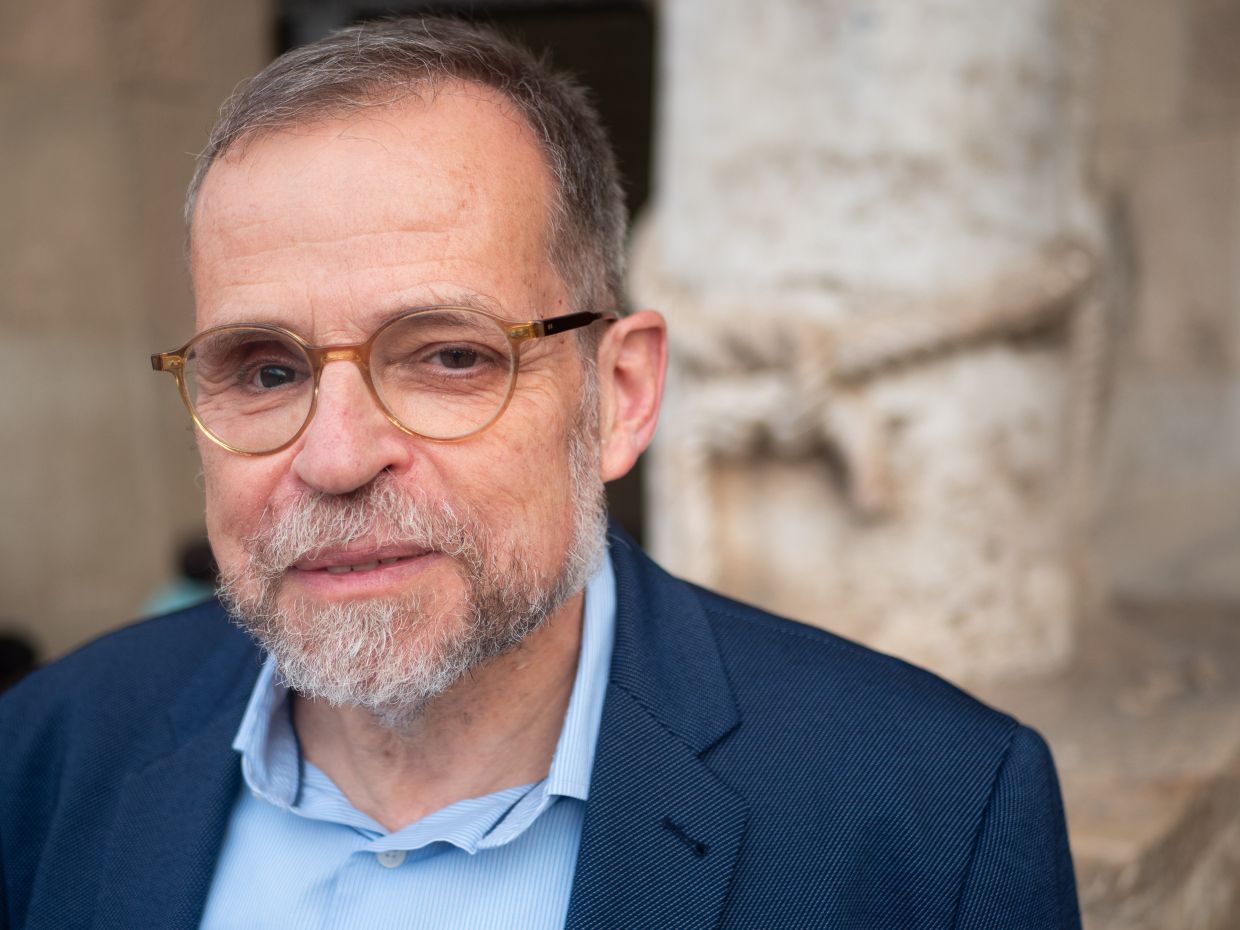 Jordi Faulí has been the chief architect of the Sagrada Familia for many years. — Photo: Andreas Drouve/dpa
Inside the Sagrada Familia, the sloping forest of columns has a fairytale-like effect. The light floods through the stained glass windows in an almost unreal way.
"There are no dark corners," says guide Christina Hartman.
During the Christmas season, visitors can witness the evening illumination of the Nativity façade – a spectacle requiring no special mass or concert.
Gaudí and modernisme
Born in Reus in 1852, Gaudí was part of a generation of thinkers committed to Modernisme, Catalonia's version of Art Nouveau.
His imaginative civil buildings Casa Milà and Casa Batlló are much visited in Barcelona. The crowning glory of Casa Milà is the roof terrace with ensembles of guardian sculptures encasing fireplaces.
A columned salon in Casa Batlló is considered the Sistine Chapel of Modernism.
Reflecting on Gaudí’s influence, Faulí says: "If it hadn't been for Gaudí, people would talk a lot more about the other architects."
He is referring to Lluís Domènech i Montaner (1849-1923) and Josep Puig i Cadafalch (1867-1956). Puig transformed a city palace in the neighbourhood of Casa Batlló into a dream world for a chocolate magnate: Casa Amatller.
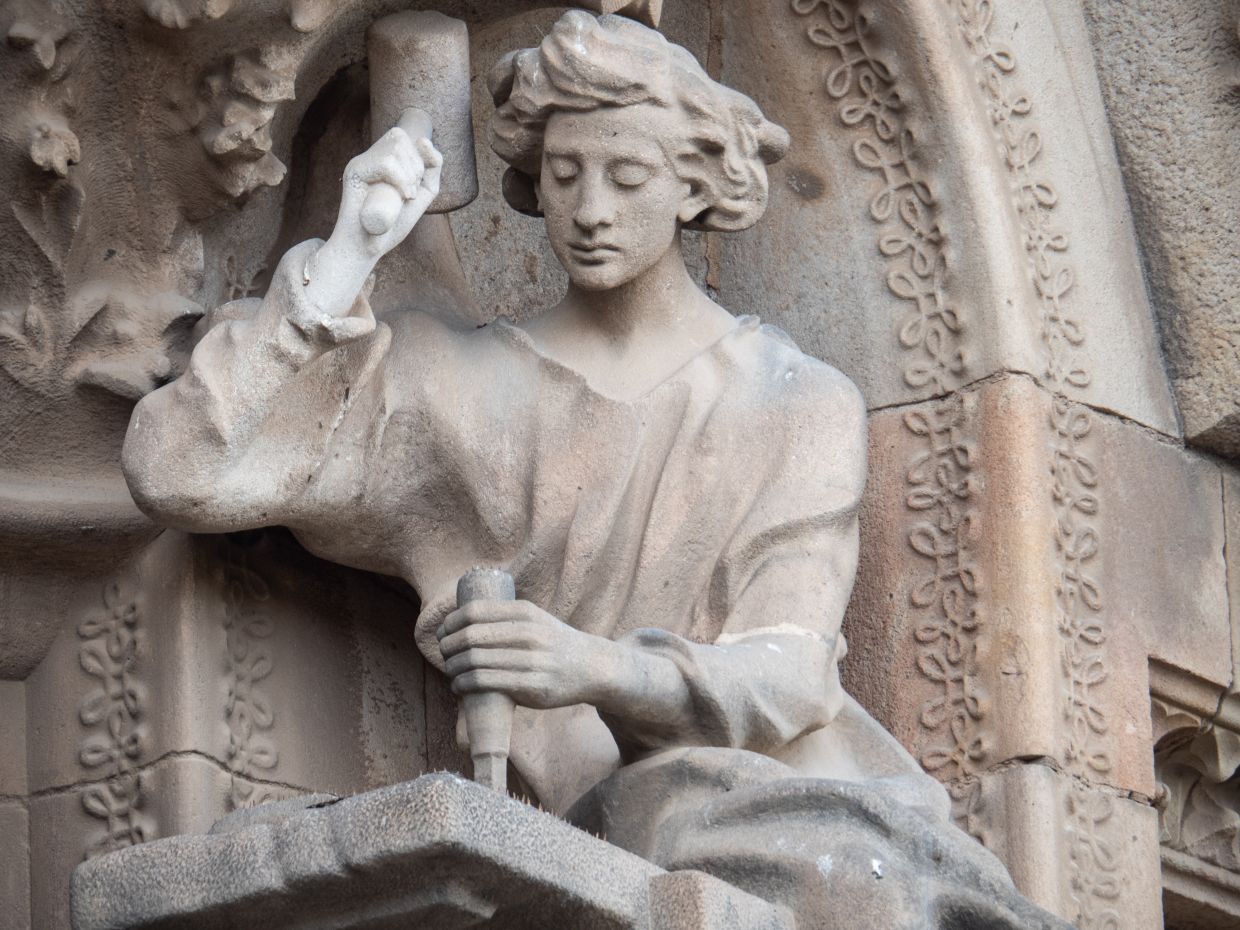 Jesus as a carpenter, sculpture on the Nativity façade of the Sagrada Familia — Photo: Andreas Drouve/dpa
Visitors feel transported into a time capsule of parlours and extravagances - right down to the laid table next to the fireplace.
Domènech's highlights were the Sant Pau hospital complex and the Palau de la Música Catalana, which is described with Catalan self-confidence as the "most beautiful concert hall in the world."
Both works are World Heritage Sites. The Torre Glòries office complex and the Design Museum next to it are architectural signs of the third millennium.
For those seeking quieter masterpieces, Gaudí also designed the Torre Bellesguard in Sant Gervasi, completed in 1909.
Far from the Sagrada Familia's crowds, it offers a tranquil garden and only about 40 visitors per day, compared to 15,000 at the cathedral, making it a serene escape from construction noise and the city's bustle. - dpa