
The highest-grossing Japanese live-action film of all time does not have any superheroes, car chases or explosions in it.
Instead, the Oscar-nominated Kokuho is a visually stunning historical drama depicting the slow, exacting discipline of kabuki theatre.
Released in Japan in June 2025, the critically acclaimed film has collected more than ¥20bil (RM501.26mil) at the country’s box office, making it the top-earning Japanese live-action film of all time.
Japanese media dubbed it a sleeper hit, its success a surprise, given the niche kabuki theme, a runtime of nearly three hours, and the lack of heavy promotion or franchise backing.
Kokuho – which opened at cinemas in Malaysia on July 23 – stars Ryo Yoshizawa as Kikuo, a young man orphaned after his yakuza father’s death, and taken under the wing of storied kabuki actor Hanai (played by Ken Watanabe).
There, he trains alongside Hanai’s son Shunsuke (Ryusei Yokohama) as an onnagata, a male actor who plays female roles in kabuki theatre, which traditionally features all-male casts.
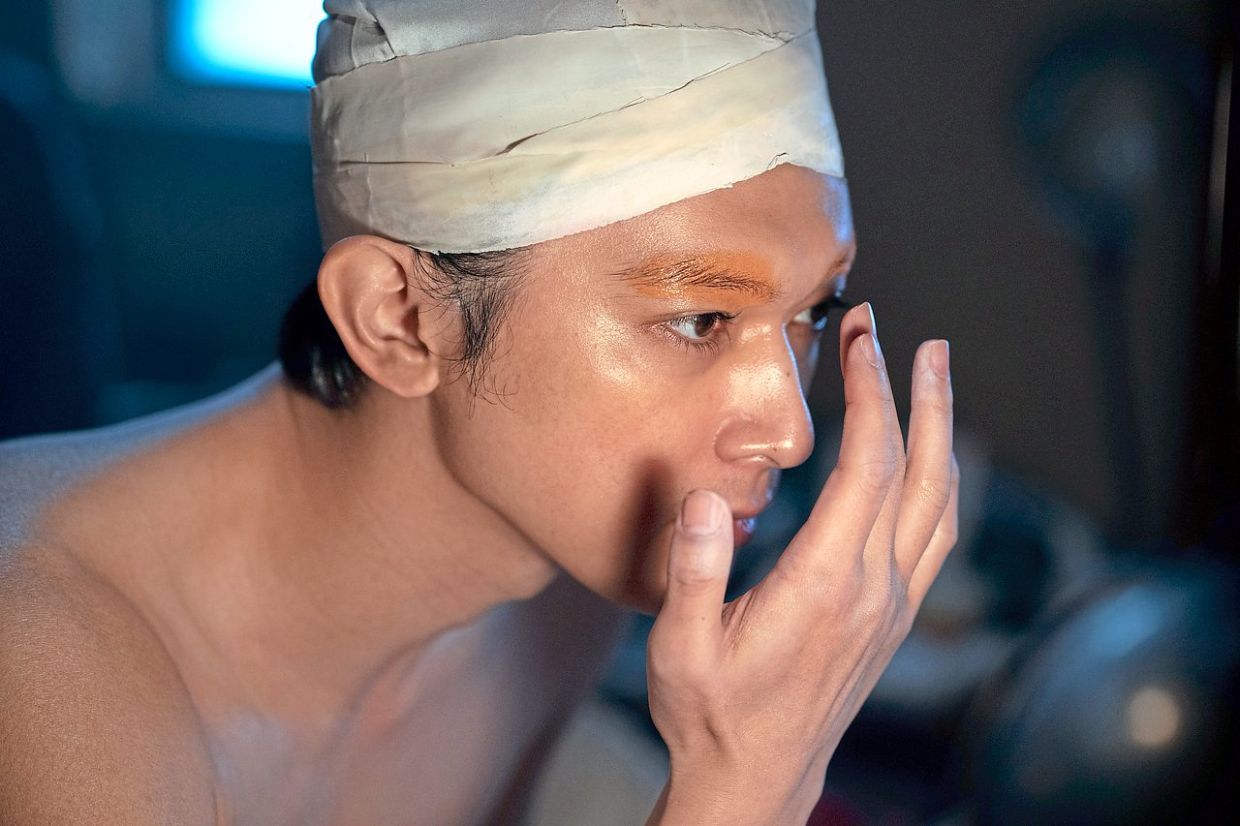
Speaking at a screening of Kokuho in New York in late 2025, director Lee Sang-il, 52, explains the inspiration for the film, which in January 2026 became the first Japanese-produced movie to receive an Oscar nomination for Best Makeup and Hairstyling.
It also swept the 2026 Japan Academy Film Prize in March with a record-breaking 10 awards, including for best picture, director and lead actor (Yoshizawa).
Yoshizawa – known for playing iconic characters in hit live- action anime and manga adaptations like the Kingdom (2019 to 2024) and Gintama (2017 to 2018) franchises – started his kabuki training 18 months before filming.
“I spent three to four months just doing the walking technique, which is called suri ashi, day in and day out,” he says, referring to the way kabuki performers slide their feet across the floor without lifting them.
“And I found kabuki to be extremely deep and difficult, although these actors make it look so easy with their elegant and natural movements,” says the 32-year-old, speaking through a Japanese interpreter.
But Lee – who directed the Japanese psychological thrillers Villain (2010) and Rage (2016) – wanted to get at the emotional core of the story rather than just the spectacle.
“This is a film with kabuki as the backdrop, but it’s really about the performer’s life.
“Of course, I wanted to be faithful to how kabuki is performed,” explains the 52-year-old filmmaker, who is ethnically Korean but was born and raised in Japan.
“That determined how we shot. But I made sure to get really close to his beautiful face so we could show what was going on internally,” says Lee, who also helmed several episodes of Apple TV’s Korean-Japanese historical drama Pachinko (2022 to 2024).
And the director demanded more than just technically flawless kabuki skills from his leading man.
“The direction I got from him was not just to dance beautifully and with perfection, but to fully become Kikuo dancing that dance,” Yoshizawa says.
The result is more dramatic than a real-life kabuki performance.
“You won’t see someone in tears onstage getting emotional very often, but that’s what we did,” the star explains.

Kokuho – based on a 2018 book of the same name by Japanese author Shuichi Yoshida – took inspiration from a real-life onnagata master as well, says Lee, also speaking through a translator.
“There was a specific actor who was an onnagata – he was very well known before and after World War II.
“He was already elderly when I found out about him, but I saw photos of him when he was young. He was also adopted in real life.
“And his gestures have this uniqueness that is not quite male, and (it’s) the same with his tone,” Lee adds.
Yoshizawa connected personally with the story’s undercurrents of ambition, rivalry and insecurity, which his character experiences first-hand.
“Actors – or people in the arts in general – can relate to this experience of getting jealous, or not achieving what you’re going after,” he says.
“Jealousy and self-doubt are things I can relate to, and these difficult emotions the kabuki artistes are going through is a world I know pretty well.
“So, I think a part of me enjoyed acting in this way.” – The Straits Times/Asia News Network
Kokuho is showing in cinemas nationwide.